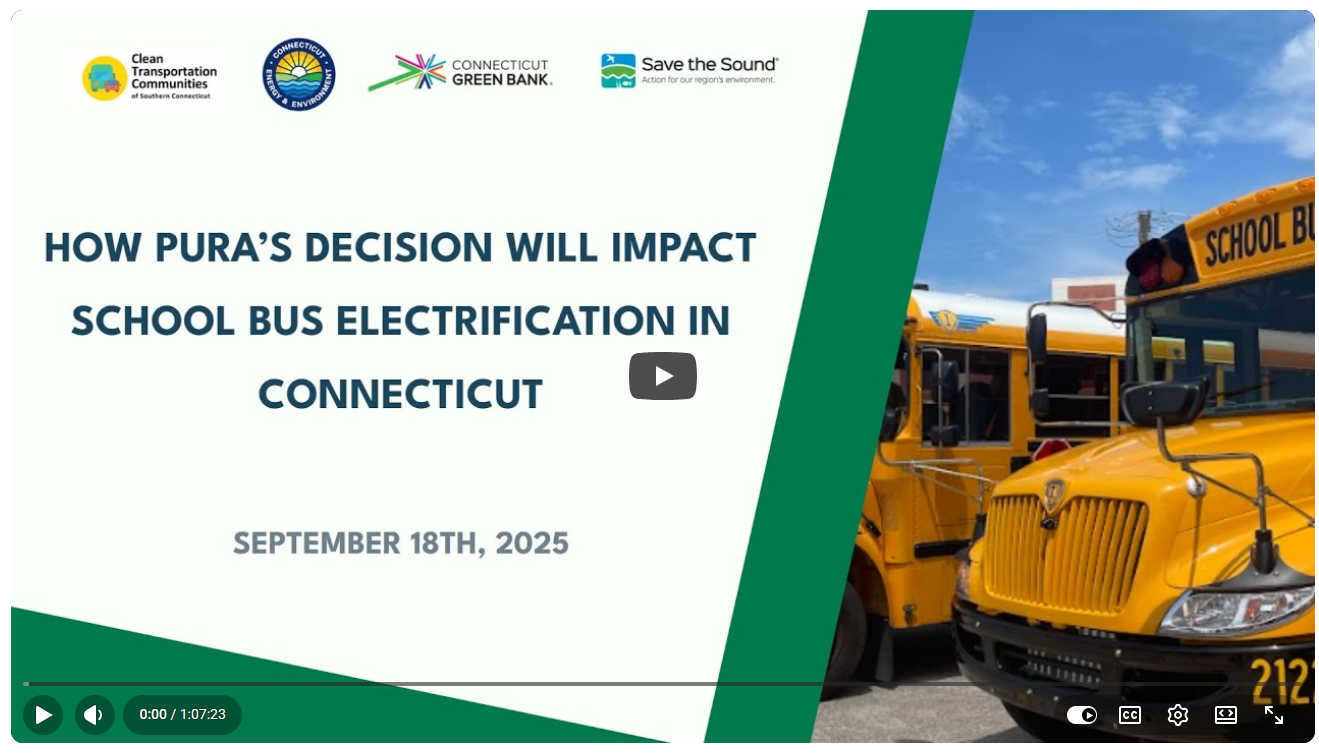
In September of 2025, Clean Transportation Communities of Southern Connecticut (CTC) hosted a webinar unpacking how the Public Utilities Regulatory Authority’s (PURA) recent decision on medium and heavy-duty electric vehicle (MHD-EV) charging will shape the electrification of school buses statewide. PURA Docket No. 21-09-17. (See webinar slides.)
Clean Transportation experts from CTC, the Connecticut Green Bank, Save the Sound, and the Department of Energy and Environmental Protection (DEEP), explored how PURA’s new docket will affect charging prices, and create more favorable charging rates for districts with clean school bus projects, in addition to new rounds of incentive programs. These new state programs will help districts who are looking to electrify to meet the state’s goal of an 100% electric fleet by 2040.
Study Finds 90% of Districts Have The Grid Capacity to Electrify
Dan Ciarcia, a sustainability consultant with CTC, kicked off our webinar with a recent study which seeks to answer if our grid is ready to handle the excess power needed for a fleet of fully electric buses. The answer is a resounding yes.
90% of school districts surveyed in New Haven, Middlesex, and New London Counties already have enough grid capacity to electrify their bus fleets. Across 40 districts, 93% of buses could be powered using existing supply. There were some small gaps in infrastructure in a few districts, but even those have the capacity to handle some new buses without major improvements.
CT Green Bank Role in Helping Districts Adopt Electric School Buses
Kevin Moss from Connecticut’s Green Bank provided details about how the new PURA docket will provide incentives to fleets looking to electrify. The Medium-and-Heavy Duty program includes:
- “Make-ready” infrastructure incentives of up to $1,300 per kW, covering utility-side connection costs.
- Shared and managed charging program to make the most out of grid inefficiencies.
- Up to 50% of EV charger hardware costs, capped at $400,000 per site.
- 10 year contracting options with Bus operators
- Fleet Advisory Services
Participating in the shared charging program can help defray energy costs by as much as 40% for school districts. Schools will also be integrated into a managed system, where buses charge at off peak times for the grid, ensuring maximum cost efficiency when using large amounts of power needed for charging. These programs will be online at the start of the year once the Green Bank launches its Fleet Advisory Services with Calstart to give technical assistance to any fleet managers looking where to start.
The Green Bank will be working with PURA’s Energy Storage Solutions (ESS) docket on an additional incentive for Vehicle to Grid technology. This technology will allow for buses to put their excess power back onto the grid during peak times, which can have an additional energy cost savings of up to 2%.
State Policy Driving Change
Charles Rothenberger, Save the Sound’s Director of Government Relations, highlighted the state laws that mandate a reduction of both CO2 and NOx pollutants, as well as the moral imperative as to some of the rationale behind these mandates.
As a state we are slightly behind when it comes to meeting our EPA Clean Air Act requirements. The state amended Public Act 22-25, An Act Concerning the Clean Air Act, in 2022 to address this, mandating that all public fleets have 100% zero emissions or alternative fuel school buses by 2040. It also establishes programs to help this transition as the state ceases its use of diesel vehicles.
Transportation currently makes up the largest portion of our emissions portfolio, and of those transportation emissions a disproportionate amount of them come from medium and heavy duty vehicles. We know that diesel exhaust is a carcinogen, and poor air quality is documented to have negative impacts on children’s test scores. All districts will have to comply with these regulations and work toward phasing out diesel buses.
In addition to the Green Bank, Paul Kritzler from CT DEEP, highlighted the state programs that fund and support electrification in the next year:
- Diesel Emissions Reduction Act (DERA) offers up to 45% of the cost for vehicle replacement, and 60% of the cost of replacement with electric engines (repower)
- VW Settlement Grant Reimbursement Program. Can fund up to 65% of the cost for electric repower or EV replacement, including EVSE
- CT Clean School Bus Supplemental Grant. The state authorized 40 Million for this program, and still has about 34 million remaining. Looking for shovel ready projects for these funds.
While federal uncertainty remains, these state programs can continue to give funds and support districts looking to electrify. Connecticut now has the policy framework, and the technical assistance to help districts implement its goal of 100% electric school fleets by 2040. Interested school districts are encouraged to join our newsletter for updates, and apply to the CT Green Bank’s fleet advisory program to help get their conversation started in their town.