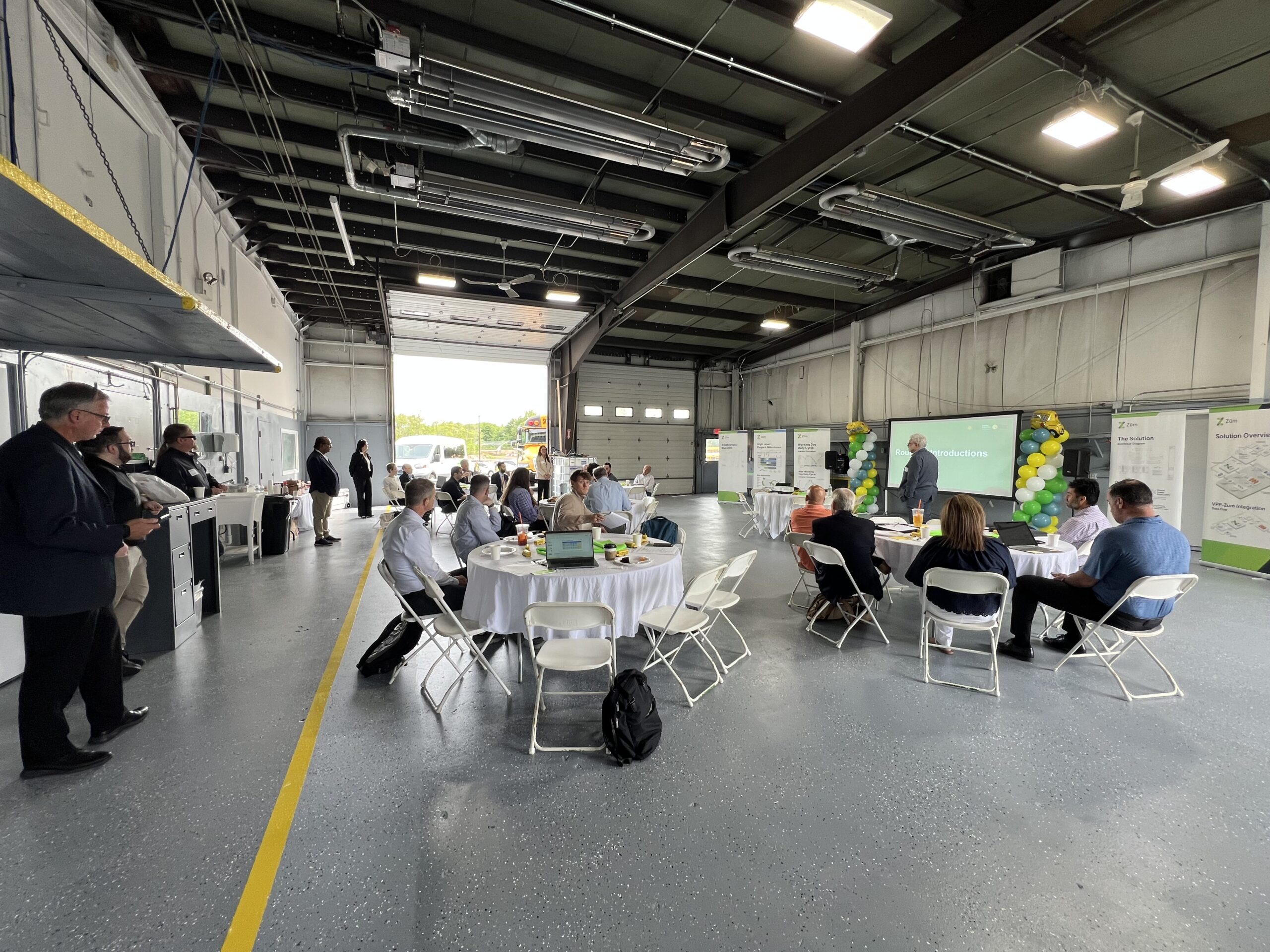
On Wednesday May 28th, The World Resources Institute (WRI)’s Electric School Bus Initiative and Clean Transportation Communities of Southern CT (CTC) convened an electric school bus (ESB) workshop at the bus yard of Branford Public Schools (BPS) and Zum, their transportation provider. Over 10 different bus providers and school districts came to learn first-hand about what the electrification process can look like, as Zum and BPS are aiming to have the first fully electric school bus fleet in Connecticut by 2026. It takes a lot of coordination to achieve this type of goal, but by working with different partners, we have the setup in Connecticut to make these projects possible. We ended the day with a ride and drive on a Blue Bird bus that was silent, clean, and more energy-efficient than its diesel counterpart.
Our workshop kicked off with a briefing from CTC Director Paul Wessel about the impact clean buses would have on our communities. We know that diesel emissions from buses are particularly harmful to young children’s respiratory systems and academic performances. Particulate matter inside diesel buses can be over 4 times higher than ambient pollution levels, and diesel engine exhaust has been classified as a known carcinogen by the World Health Organization. This problem is particularly pronounced in Connecticut, where half of the counties have received failing grades from the American Lung Association (ALA), and low-income communities of color have about a 3x greater risk of developing asthma, COPD and cancer. Yet we choose to put our kids in close proximity twice a day, every day for 180 days a year in diesel-fueled vehicles. Connecticut passed Public Act 22-25 that aims to have 100% zero-emission school buses statewide by 2040. Even with that legislation we still lag in ESB adoption. While electrification does present some challenges, there are a lot of resources available for these projects. Branford recognized this and chose to do something about it.
BPS Superintendent Dr. Chris Tranberg and BPS COO Blaize Levitan presented next, giving an overview of some of the logistical, political, and local challenges it took to get the contract both set up and then accepted by the public. Having worked through a number of bumps since the start, Dr. Tranberg stressed how being open with information and working with local officials early really can help to smooth the transition. He cited finding specific advocates on the Board of Ed and the representative town committee (RTM) to be a district’s champions, but also mainly to combat misinformation. There were numerous times where the contract was questioned, and local leaders can really help quell local nerves. The town and Zum received $6.5 million in EPA Clean Heavy-Duty Vehicles Grant Program (CHDV) funds from the federal government, $6.5 million in DERA (Diesel Emissions Reduction Act) grants from the state, and then $12 million in low-interest financing from the CT Green Bank (with $1.8 million coming from DEEP) –all making it possible to pursue the first fully electric fleet in the state by 2026. A key aspect of the contract is that Branford leaves most of the complicated and challenging electrification work to the experts, their bus provider Zum.
Zum’s Director of Electrification Program Management, Dr. Pallav Prakash, spoke on how the bus system is like a body, and you need all parts working and optimized to provide the best service. Citing his service in the Indian Navy on electric subs, the technology has been around for a long time. It’s just about implementing it the right way to get the most efficiency. Their ‘brain’ is the operating system and app they have implemented that has amazing features like better routing with AI, GPS tracking, and video software to know what’s happening on every bus at all times. That is not even to mention that everything will be electric, with zero emissions. There are many infrastructure challenges to work through, and if your ‘lungs’—the buses—are not operating properly, neither will the rest of your body.
Brendan Sharkey, co-owner of Daisy Solutions, a renewable energy partner of the Association of Educational Service Agencies (AESA) and Area Cooperative Educational Services (ACES), spoke on how they were awarded a CHDV grant that allowed them to purchase 6 ESBs. They have a unique arrangement that allows them to bypass the RFP process, making it a lot easier for them to write grant applications. GridEdge Networks was awarded $500,000 to demonstrate the integration of an ESB fleet with the grid to enable V2G capabilities at the ACES bus yard in North Haven. The lessons learned from this project will be crucial for building a model of cooperation that can be repeated statewide at scale with Eversource and United Illuminating.
We had numerous presentations from state and local partners about the resources available to districts across CT. Katilin Stern, Environmental Analyst at CT Department of Energy and Environmental Protection (DEEP), outlined programs such as the CT Clean School Bus (CT CSB) Supplemental Grant Program that has $20 million in funds under PA 22-118, and over $17 million in VW settlement funds that have to be spent before 2026. Repowering (retrofitting existing buses) is eligible for 60% state funding support. So even with challenges at the federal level, Connecticut has resources to help deal with disruptions, including its invaluable Green Bank. Peter Cyr, Program Manager at CTC, gave updates on the federal support landscape and the status of lawsuits Connecticut is part of. While court cases tend to be going against the administration and the latest awards from the Bipartisan Infrastructure Law and Inflation Reduction Act are being released, the passage of H.R.1 – ‘One Big Beautiful Bill Act’ – will largely terminate the IRA’s tax credits. In brighter news, $5 billion in National Electric Vehicle Infrastructure (NEVI) funding should soon be made available to states, including $57 million in approved funds for Connecticut.
The CT Green Bank is a first in the nation entity in Connecticut that can help school districts with unique financing opportunities that reduce emissions. Kevin Moss, Senior Manager of Clean Transportation, outlined how they are working to get more favorable electric rates for ESB charging through the Public Utilities Regulatory Authority (PURA) Docket 21-09-17, how they offer low-interest financing for green projects, and also allow for 10-year bus contracts which help immensely to make the TCO (Total Cost of Ownership) payback work. The Green Bank’s Energy Storage Solutions (ESS) program is designed to increase climate resilience and provides opportunities for peak demand management. If implemented, districts enrolled in the ESS program could see lifetime payments of around $40,000-$60,000 per bus. Zum stated numerous times that without the Green Bank the numbers would not have worked. They were immensely grateful for how easy Connecticut made it to adopt ESBs, as opposed to California where they have a lot of bureaucracy to cut through.
Representatives from both of CT’s major utility companies were in attendance, with Brian Morris, Manager of Clean Energy Policy at United Illuminating, and Kevin Boughan, Manager of Clean Energy Strategy: Electric Vehicles at Eversource. Boughan gave a presentation on how districts can engage with their utilities on the path to fleet electrification. After reviewing the available state and federal funding opportunities, Boughan brought up Vehicle To Grid (V2G) charging, which can help lower the cost of school bus electrification and expand its benefits. Over the past several months, BPS/Zum has had separate meetings with CTC, the Green Bank and Eversource to discuss how V2G would help lower their Total Cost of Ownership. PURA Docket 21-09-17 could set up a wider V2G pilot program, which would set up an incremental revenue stream to offset transition costs and provide community benefits. When demand for power is high, often when air conditioning is heavily used on hot summer days when buses are not operating anyway, electricity stored in the bus batteries from off-peak charging sessions can be reinjected into the grid, and vehicle operators are paid based on the duration and frequency of each event. Ultimately it takes a coordinated approach with the utility provider to ensure that each district has the safest and most efficient approach to their transition.
The last presenter was Brittany Barrett, Deputy Director of Implementation & Operations for WRI’s Electric School Bus Initiative, our project sponsor. She presented on the “taxonomy” of business models associated with ESB adoption and negative externalities from diesel buses like air quality and environmental decay. She also stressed how essential it is to have a plan and a transition that makes sense for each district’s fleet size and economic capabilities. Despite federal challenges, WRI continues to push the ball forward on ESB adoption, providing vital resources for school districts that are looking to make their transition. One of these resources is WRI’s Electric School Bus Electrification Roadmap, which provides key steps and considerations to guide districts in planning their fleet electrification. Through their research and funding we have seen a steady continued push toward a cleaner transportation system. They recognize the damage and harm that poor air quality inflicts on communities and are committed to reducing those impacts on the next generation.
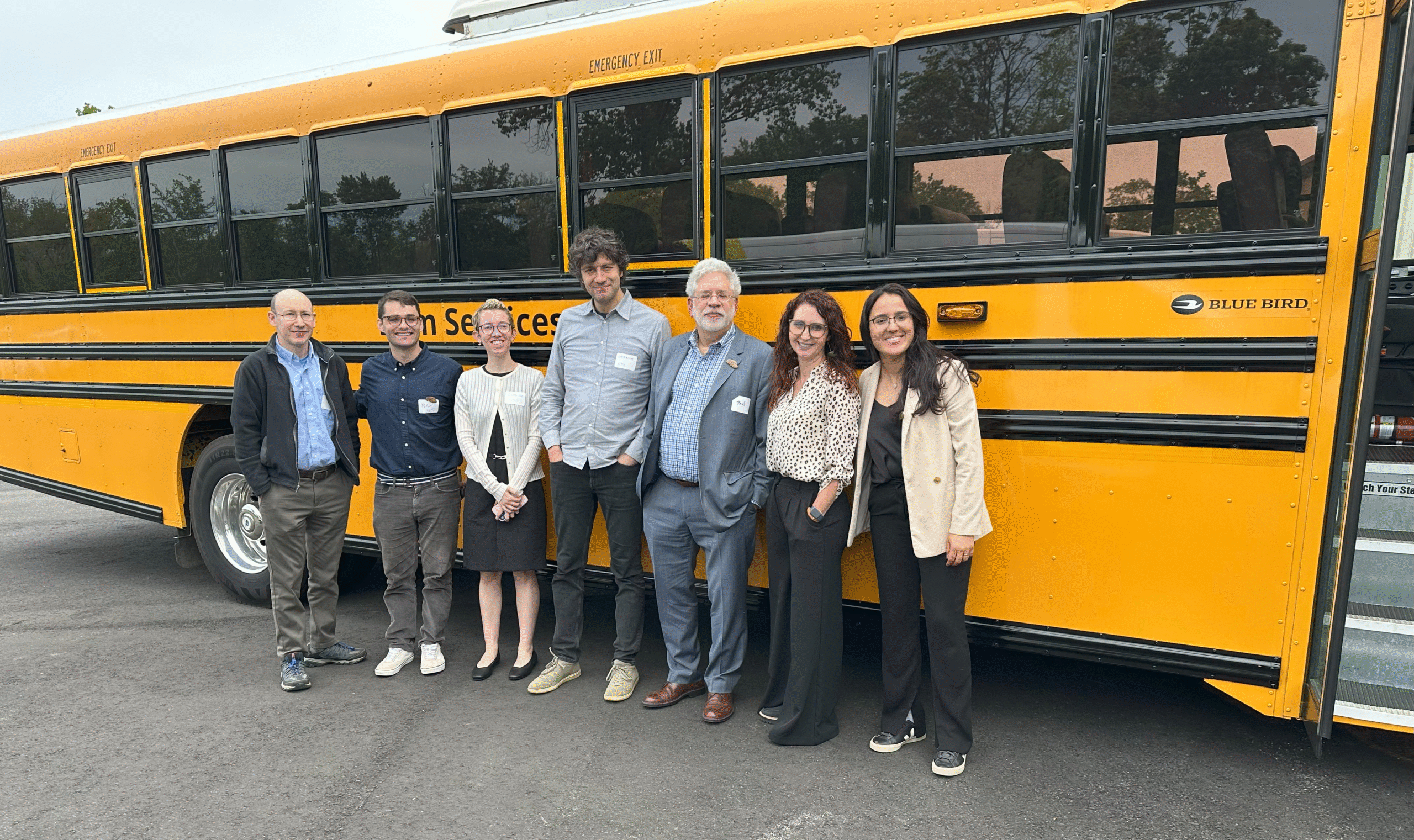
To round out our day, the ride and drive featured two different vehicles, a Ford E-Transit medium-duty 10-passenger van, and a 100% zero-emission Blue Bird Vision Electric school bus with a Revo E Global cooling system provided by Valeo. The transit vans have been a critical component of Zum’s early electrification strategy for BPS, as they have fast lead times, more streamlined use cases, and help accelerate the transition while working on the more involved process of procuring the charging infrastructure required for the larger ESBs. They help fill the gaps with special education, sports teams, and other smaller/special functions. The Blue Bird bus ride was remarkably smooth, and you could not hear it while it was idling. Another awesome feature is that these buses have GPS tracking that is linked to the Zum app, so parents know exactly where their kids are. Monitoring systems inside the bus also allow staff to supervise the behavior of both the driver and the students—these features have significantly helped to get buy-in from parents.
Overall, the road to electrification will take more work, and has some implementation challenges, but working with project partners and having a smart plan can make these obstacles surmountable. With 10 school districts in attendance and over 30 receiving workshop resources, we are confident this workshop will push the conversation around ESBs forward in our state. We have seen Branford’s steadfast commitment to zero emissions, and the coordination it takes to actually achieve it. We celebrate Zum and Branford for moving the ball forward on this issue and setting the standard for all school districts in the state. Their model will be the foundation for many more electrification plans to come.